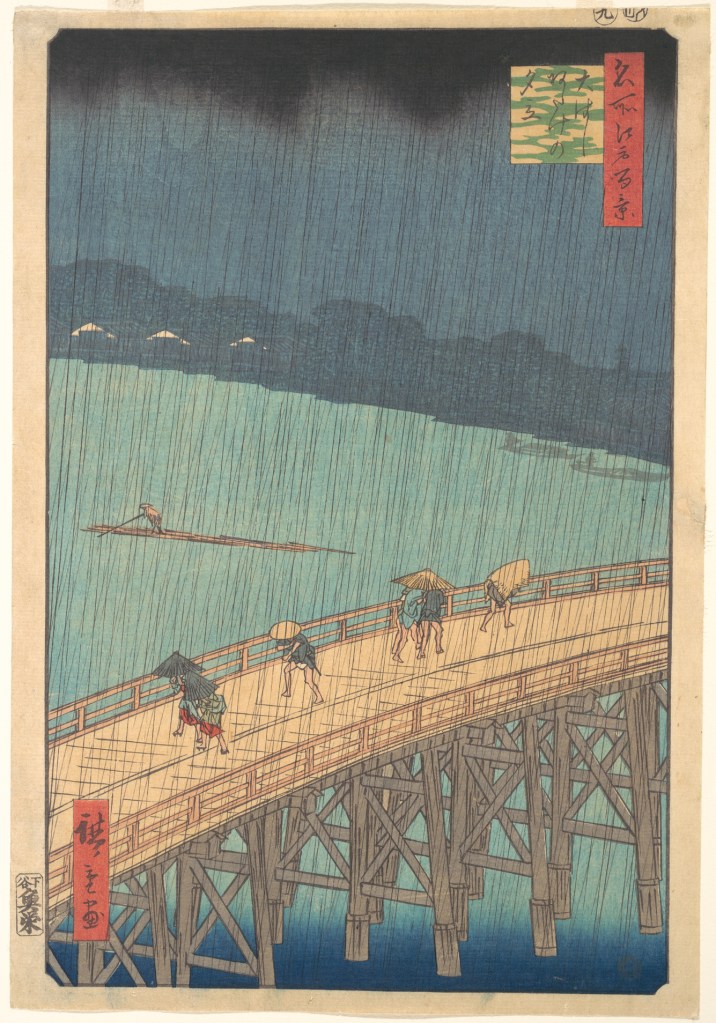

I first was made aware of this work through reading about Utagawa Hiroshige’s (1797-1858) “Sudden Shower over Shin-Ōhashi bridge and Atake”. Vincent Van Gogh, according to Thomas J. Craughwell, was very much inspired by Japonisme, a movement that was flourishing in Europe in the 19th century. Exposure to Japanese art, thanks to trade, had inspired many artists at the time.
While Van Gogh had imitated Hiroshige’s print, there are noticeable differences that seem to make this more of an appropriation, rather than a copy. For starters, the Dutch artist had used oil paints, rather than the Ukiyo-e wood block technique. As a result, his rendition seems to have more depth, compared to the flatness of the original. The waves appear to roll tumultuously towards the figures on the bridge, as if a tsunami is just on the horizon. In direct contrast to this, Hiroshige’s waves have a stillness which does not seem to threaten the figure that is rowing within it. The water is clear and calm and the rain does not seem to pelter on the scene. It is a shower, but not a heavy one.
Van Gogh’s oil painting however, evokes a different mood. Not only are the waves more violent, towards the top frame of the painting, there are what appears to be dark clouds: a storm is well on its way. If Hiroshige was trying to depict a summer shower, Van Gogh was showing a natural disaster that is about to begin. The bridge, although appearing very stable, seems dwarf in comparison to the waves that will no doubt wash over everything. There is no protection or solace for the figures, only desperation and urgency.
Although it is very easy to ask which work is better (and I am sure as you are reading this, have already come up with an opinion already), try asking instead what the intention of each artist was? After all, Van Gogh’s personal traumas were widely a known aspect in his biography and can be seen in almost any painting of his. However, it is not as well known what was going on in Hiroshige’s mind when he created his print. But if one were to look at a work and try to better understand the artist’s intention and processes, rather than taking the work simply at face value, there may be a greater appreciation of the result.
 Critical Art Writings
Leave a comment