As mentioned in one of my previous blogs, conceptual art can be unpopular with mainstream audiences. That isn’t to say that conceptual art doesn’t have a place: It absolutely does. Art for centuries has not been without controversy, with works spanning from Impressionism to Dadaism startling and making audiences think differently about art. More importantly, these works not only provoke us to think differently about our aesthetic ideas about art, but also about issues surrounding politics, religion and life itself. In the case of Dadaism, we have seen every day objects taken from their original context and placed into a gallery so to alter their function to that of an art object. Marcel Duchamp certainly did this with his readymade urinal, Fountain (1917), a highly provocative work for its time.
But there is a limit to how much a work can challenge audiences. Now in the 21st century, with information readily available at our fingertips through the Internet, one does not need to be an art expert, nor a frequent viewer of exhibitions to see the recent developments of conceptual art. Maurizio Cattelan’s Comedian (2019) is omnipresent, circulating even further through memes as well as remakes and reinterpretations. As a result, audiences become only too familiar of overpriced conceptual works of art that it begs the question as to whether these are really works of art, or simply random objects put together for the sake of profit. These works often lead audiences to scorn such works, and sadly, the arts itself, but more on that later.
This brings me to my main point. Recently, I had visited the Nillumbik Contemporary Art Prize exhibition, held across three gallery spaces at the Montsalvat Artist Community in Melbourne’s north east. Generally, this a great opportunity for emerging artists to be noticed and win generous cash prizes, two things that are crucial for any artist. Given lack of funding towards the arts sector, such a program is all the more important. The exhibition itself is curated quite nicely, with the bulk of the exhibition located inside the Barn Gallery. There is a variety of works of different mediums, from video and sound works to painting and sculpture. When walking in, it is clear to the viewer that there are many different exhibits that all command their attention, and therefore, preventing museum fatigue.
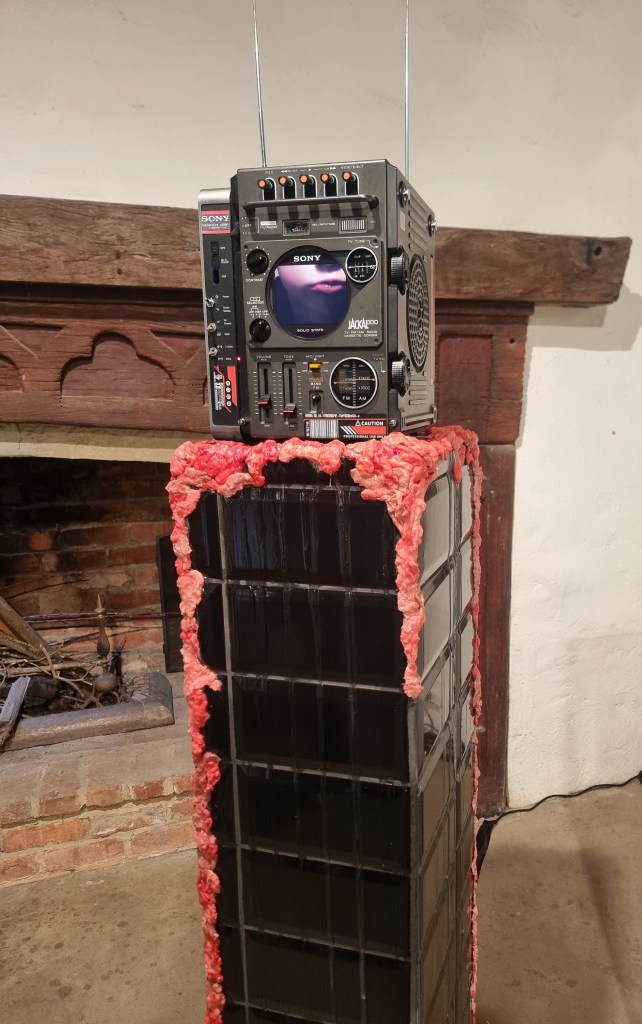
So a nicely curated exhibition with a noble intention to assist contemporary artists. What could be wrong with that? Unfortunately this becomes apparent as you draw closer to the works and inspect each one individually. Jen Valender’s The Future Isn’t What It Used To Be (2024) is such an example. The work combines various elements: A modestly scaled sculpture made from reddish chewing gum with a tiny porcelain hat on it and a large speaker with a small screen showing a repetitive video of a child chewing gum, the sounds reverberating on the speaker. The same chewing gum is stuck along the edges of the speaker, for reasons unknown to me except perhaps to either hone in on the point of the gum being central to the work, or to add an element of shock. Once you get over the initial feeling of revulsion and watch the video, there is a repetitive element of the chewing gum video and sound effects, seeming to portray a nostalgia for the past where a better future was envisioned. As intriguing as this theme is, there is very little connection between that and the work. If the contextual label was removed, it would be pretty difficult to know that this is the meaning that Jen is trying to convey. Chewing gum is certainly an act that we can connect with childhood, but to connect this with an idea of “the often harsh realities of (agri)cultural practices; of nostalgia for perceived innocence” seems like a pretty big leap of logic. The fact that the artist had selected lactose intolerant adults and children to record chewing gum is unknown, and again does not seem to really show in the work unless one reads the contextual label. Furthermore, for someone without a background in art theory, would this meaning be easily discerned?
Stepping into the Resident’s Gallery, it is impossible to not notice Lada Dedic’s installation Self Portrait in Analogue and Digital Confusion (2024).108 ready-made hotel call bells are positioned throughout the space, some on a more conventional sculptural plinth, while others are scattered around random corners of the gallery space, such as the fireplace and window sill. If we look back to our earlier example of Marcel Duchamp’s Fountain, it is a bit more obvious what Lada’s work is about. Unlike Duchamp though, Lada has not only transformed these commonplace objects into a work of art with the use of a plinth, but also encouraged audiences to interact with them; an act traditionally forbidden in most cultural institutions. It is also clear that she is transcending the idea of an artwork being in its designated spot on a plinth, by placing the bells in random parts of the space. What isn’t as obvious however, is the exploration of “the fine line between implied consent, subtle pressure and the unspoken shadow of shame sometimes felt in the cultural industries”. While mainstream audiences would be familiar with found objects in art, the institutional critique would be less apparent. All audiences would see, unfortunately, are a series of hotel call bells on plinths and scattered around the gallery. Once the novelty of pressing the bells wears off, one would be left wondering what the point is. Why is it a self portrait, except for the point that the surfaces are reflective? And where is the digital confusion when these are analogue objects? At least the confusion part of the title is accurate.
As mentioned earlier, art is supposed to challenge us to think differently about the aesthetic qualities of art, as well as making us think and rethink bigger issues. These works certainly do make us think differently about the way art is meant to be presented, by using objects that are not traditionally associated with art. But when the meaning of these works are not overtly clear to the audience, it can be very difficult to make us think about the bigger issues. For those of us with an art theoretical background, such motivations of the artist can be clearer, but for those who just want to look at an exhibition for art’s sake, these meanings and motivations are all lost. What then, is the point of these works in being displayed in a location with such high foot traffic like Montsalvat, when the themes are only discernible to one particular audience? And what if this is an audience of exclusively university-educated artists and curators? For those who are artists who are not familiar with the concepts of institutional critique, this would be all the more alienating, like belonging to a group but never being in the “in” crowd. To make matters worse, for those who already scorn the idea of a found object being considered a work of art, such works would be nothing more than a joke, or an excuse to receive money without much effort.
Now, I am not saying found objects can’t be considered a legitimate work of art; rather, I am more wary of how audiences who already have these preconceptions would perceive these works and consequently, the arts sector itself. With audiences who already scorn the arts as having gone downhill from this focus on profit with found objects, these same audiences could be made up of those in power: Politicians or wealthy patrons. If these people with the money, power and influence cannot connect with the meaning of an artwork, who are left out and alienated by the obscure message, how then can the arts be adequately funded? Of course, the arts should not seek to pander to those with the money and influence, but they should at least be accessible. If messages are only obvious to those of a fine art university background, how then can everyone else understand? The arts is already underfunded as is, so it would be self-defeating to make it more exclusive, rather than accessible.
This exhibition was not without some strong works, however. Nicholas Hubicki’s Terraphthora #7 (2004) inkjet print cleverly combines traditional and unorthodox photography techniques, while drawing focus to the way land is exploited by mining. Isabel Trufas’s eye candy (2004), too, is a striking work with a skillful use of acrylic paint that makes one think about subcultures and objectification, all with the eerie Orwellian use of staring eyes. Although the meaning of these two works were not clear without reading the contextual labels, they at least make us pause and think, rather than feeling disengaged and alienated early on. Messages need not be directly obvious, but if works are presented in an already contentious medium as a found object, this makes audiences struggle all the more to connect to the work. If we really want to support artists and ensure that it remains a stable sector for future generations, then arts organisations and judging panels need to find a way to make audiences appreciate art, rather than repelling them altogether. While controversy is an effective mechanism to bring a message to audiences, controversy very quickly evaporates into boredom once the initial shock wears off and the meaning is lost. In this information-saturated age, we’ve seen the way found objects can startle audiences and make them scratch their heads. But now, we are becoming so desensitised to the point that they no longer have the effect they used to.
If we want the arts sector to endure and be more sustainable, we need another way to bring audiences back to our galleries. Perhaps, more of a consideration for works with traditional mediums that display a degree of skill, could be the solution.
 Critical Art Writings
Leave a comment