Over the centuries, flowers have been used as a staple subject matter. Whether one is a painter, drawer, or photographer, floral imagery is largely omnipresent in people’s houses, gift shops, small galleries, and large institutional spaces. Taking all of this into account, it makes sense that an exhibition related to a Wunderkammer (German: Room of Wonders) would focus on this. Around the 16th century, members of the aristocracy had collected objects from artwork to archeological and scientific specimens to display in a designated room of their house. These rooms were a mark of how well-travelled or how wealthy the owner was: their purpose was entirely reputational. The curatorial team that had put together Floribunda probably envisioned a wealthy, albeit eccentric enthusiast of flowers who collected all things floral-related. Unusual, but plausible. Eccentric wealthy people do exist, after all.
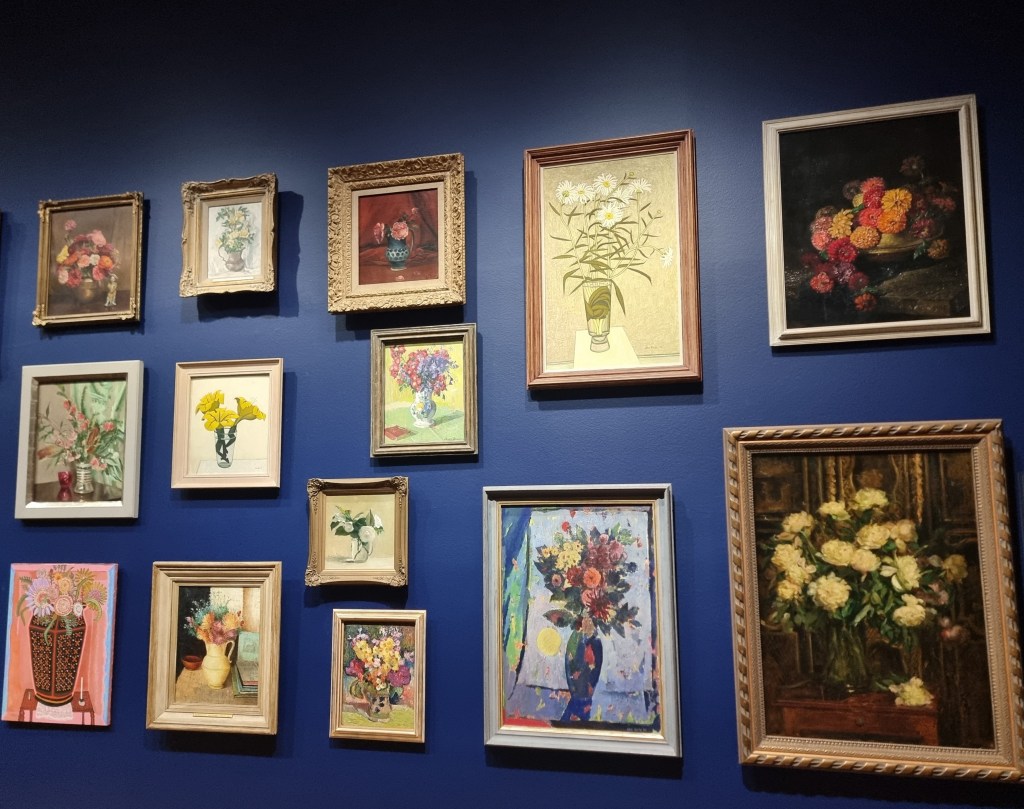
Floribunda is housed within the colossal Bunjil Place in Narre Warren. The venue itself was difficult to get to for those of us who are not from the south side of the Yarra River, but I digress. When walking in, (anti-clockwise) we are surrounded by dark, seemingly royal blue walls, perhaps a reference to nobility. On the left, a wall is covered in a salon hang of various paintings of flowers, spanning different time frames, mediums, and styles. Even the frames of these are all completely different: Some having plain frames or none at all, while others are surrounded by ornate ones. A salon hang typically involves more than one row of works (often three or more), and is a rather traditional, hierarchical style of hanging as the further away a work is from eye level, the less “successful” it is. Being familiar with curator David Sequeira’s work, I was expecting to see if not a complete imitation of the salon hang, perhaps a subversion of one. David often does this by reversing the prominence of white colonial narratives, as is the case of his residency project, 50 Shades of Grainger. Put briefly, this was an exhibition that reversed founder Percy Grainger’s reputation of a well-respected figure to a sadomasochistic, morally questionable character by bringing his private objects out from storage to public display. Looking back at the salon hang at Floribunda, I thought perhaps the lesser-known works by artists of marginalised backgrounds might have been placed at eye level, while the recognised works by artists of white colonial backgrounds would be in less prominent areas. Unfortunately, this was difficult to discern. Upon researching this exhibition later, I discovered that the curator had hung colonialist works alongside colonised works. All of this was unknown to me at the time, though, because what was most prominent was quite a bizarre wall hang. Works of varying scales were hung side by side, without any attention paid to symmetry or balance. This made little sense when looking at the other parts of the exhibition, which had a very precise and meticulous hanging procedure. Needless to say, to someone without an understanding of curatorial theory, this looked jarring and disjointed, especially in the context of the other installations.
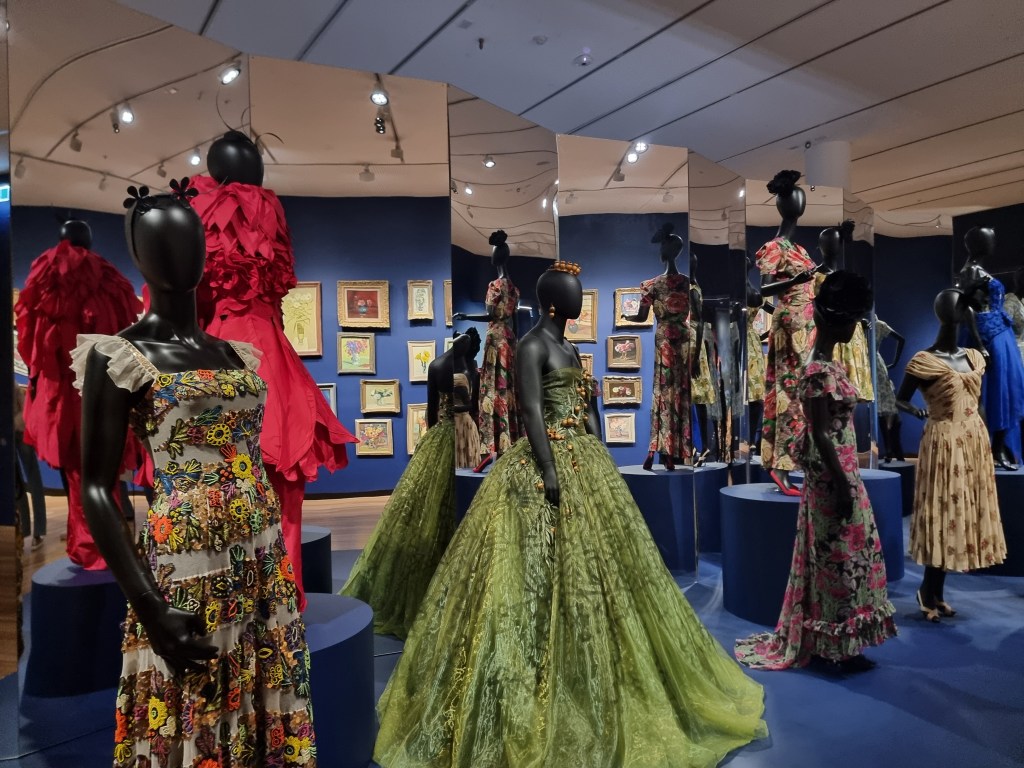
But when looking at art, one needs to keep an open mind. Aside from the haphazard salon hang, the exhibition is rather aesthetically pleasing, at least in a blockbuster way. Directly facing the salon hang is a long series of connected wavy mirrors which create distorted reflections, much like a fun house at a carnival. A group of mannequins stand in front of these mirrors, all in elegant dresses with floral patterns and motifs. Even the headwear and accessories of the mannequins are flower-related, tying in well with the theme. Yet, while this was all very nice to look at, positioned right near the salon hang made little sense, and with the singular mannequin near the entrance, even less so. This display technique is reminiscent to the group of mannequins showcasing Kusama’s designs at NGV’s past Yayoi Kusama exhibition. While this no doubt brought in much attention from audience members, it makes little sense considering the wunderkammer theme of the exhibition. Is Floribunda supposed to be loosely based on an eccentric aristocrat’s collection of flower-based objects, or is this meant to be one of NGV’s famous blockbusters, albeit in the southeastern suburbs?
While there were aspects that demanded attention from audiences, there were also aspects that felt superfluous and were overlooked. The ceramic pieces that were within the glass cases centered towards the back of the space contained examples of Asian and European works. While these works had flowers, which linked back to the main theme of the exhibition, they still seemed out of place. Although these objects were more in line with what a wunderkammer would contain, against the more contemporary, blockbuster aspects of the exhibitions, these paled in significance. This is especially the case when one walks towards the very centre of the space, which is sectioned off by dark walls. Much like the fun house mirrors and well-dressed mannequins, this smaller room contains an element of the blockbuster. Unlike these other aspects though, this section also portrays the wunderkammer theme well. Several plants and flowers are encased in blocks of resin, all stacked neatly within this small space, like a mini laboratory. Given that wunderkammer owners also possessed scientific artifacts as well as works of art, these illuminated blocks of resin is consistent with the theme. Having seen this same work (Azuma Makoto’s A Chaotic Garden) at the 2024 Triennial, this smaller, more intimate space works better with these works. The viewer is able to properly inspect these specimens rather than being overwhelmed compared to when they were in a bigger space at the NGV. Against these ceramic pieces, Makoto’s work stands out significantly, outshining them altogether.
There’s no denying that generally speaking, David Sequeira does well with the aesthetic elements of the exhibition. Given that David had to work exclusively with works from the NGV Collection, it would be a challenge to try and find some level of continuity within them. Still, it is important to note that even with a nicely set out exhibition with decent works, the message and meaning must be accessible to audiences. Sadly, this is where Floribunda misses the mark. Near the ceramics, at the very back wall is a neat arrangement of various drawings of flowers. Between each drawing, however, is a quote which is printed directly on the wall. The quotes seem to come from a variety of sources, from famous pop musicians to poets. All these quotes contain references to flowers, which again, ties in with the theme of the exhibition. Unfortunately, while both the quotes and the works relate to flowers, the eye is drawn more to the text instead of the flowers. The royal blue background and the white text detracts from the black and white drawings, making this arrangement more disjointed and not as unifying as it could have been. Perhaps the quotes might have been better in a space of their own, or at least with works that had more colour so that they can equally command the viewer’s attention.
Conversely, the white text on blue, while giving the appearance of a blockbuster exhibition, was ironically hard on the eyes. Although this text detracted from the work when on the wall and in large font, it became inaccessible when on a smaller scale, particularly on wall labels. As my companion pointed out, the white text on a dark background was more difficult to read in comparison to dark text on a white background, Being short-sighted, I struggled to read this text myself: even with the assistance of glasses. To make matters worse, some of these labels were placed on a raised platform (a tripping hazard itself) on the floor underneath the works. To find out more about the context, both my companion and I had to crane our necks to read. Alas, we both gave up when it became too much of a hassle. This was further exacerbated by the limited lighting, though I understand for conservation purposes, this would help slow the process of degradation for fragile works. Still, I dread to think how inaccessible such contextual information would be for those with a greater degree of visual impairment. Additionally, even with labels positioned on the wall, more than one work was on a single label, making locating and identifying the corresponding work on the wall to be more of a chore. These issues thus, made the meaning of the exhibition more obscure.
While it is clear that Floribunda is an exhibition about flowers, even the title of the exhibition is specifically about roses, not flowers in general. Furthermore, the introductory text at the entrance of the space mentions that this is an exhibition that explores the “special relationship” between humans and flowers. As stated, there is an abundance of many different depictions of flowers, but this examination of the “relationship” between flowers and art is not so obvious. Taken at face value, each work contains a flower, which corresponds to the theme, but where is this relationship? If we cannot find this through the installation itself, then the contextual labels must be legible enough to provide that.
Overall, Floribunda, while mostly visually pleasing, raises questions about the flow and arrangement of the works. It is an exhibition that tries to do too much, and as a result has an identity crisis that causes confusion. Aside from Makoto’s resin-encased garden, this exhibition awkwardly tethers between an aristocrat’s wunderkammer and a blockbuster exhibition. A wunderkammer is a private space, one that only people with connections to the owner could have access, whereas a blockbuster is a public space, designed to bring in as many audiences as possible. These are two conflicting modes of curation, so it makes little sense to try and do both, when one can be chosen and done well. Although the salon echoes the traditional style of hanging, the unevenly spaced works were distracting. It was only from further research that we get the understanding that these works were hung in that way for a reason. Unfortunately because of this need to make an aesthetically pleasing spectacle of an exhibition, contextual aids were difficult to access, causing the meaning to be lost on audiences. While some works related to the theme of the exhibition, they were overlooked because of the stronger, more eye-catching works. With having a more consistent curatorial style and a clear message, Floribunda would be better understood and thus, more successful.
 Critical Art Writings
Leave a comment