One does not need to be an avid follower of politics, nor a regular news consumer to know that there is much upheaval regarding the state of the world these past few years. In 2023, Kellie-Jay Keen-Minshull (Posie Parker) held a “Let Women Speak” event on the steps of the Victorian Parliament, an anti-trans rights protest that was later joined by neo-nazis and even led to turmoil amongst the ranks of the Victorian Liberal Party (but we won’t go into that here). In summary, the women involved in this protest argued that women’s rights were being infringed by transwomen entering women’s spaces, painting transpeople as perpetrators under the guise of feminism. It was this very protest that spurred artist Alistair Fowler to create a body of work which formed the exhibition Another Quiet Protest.
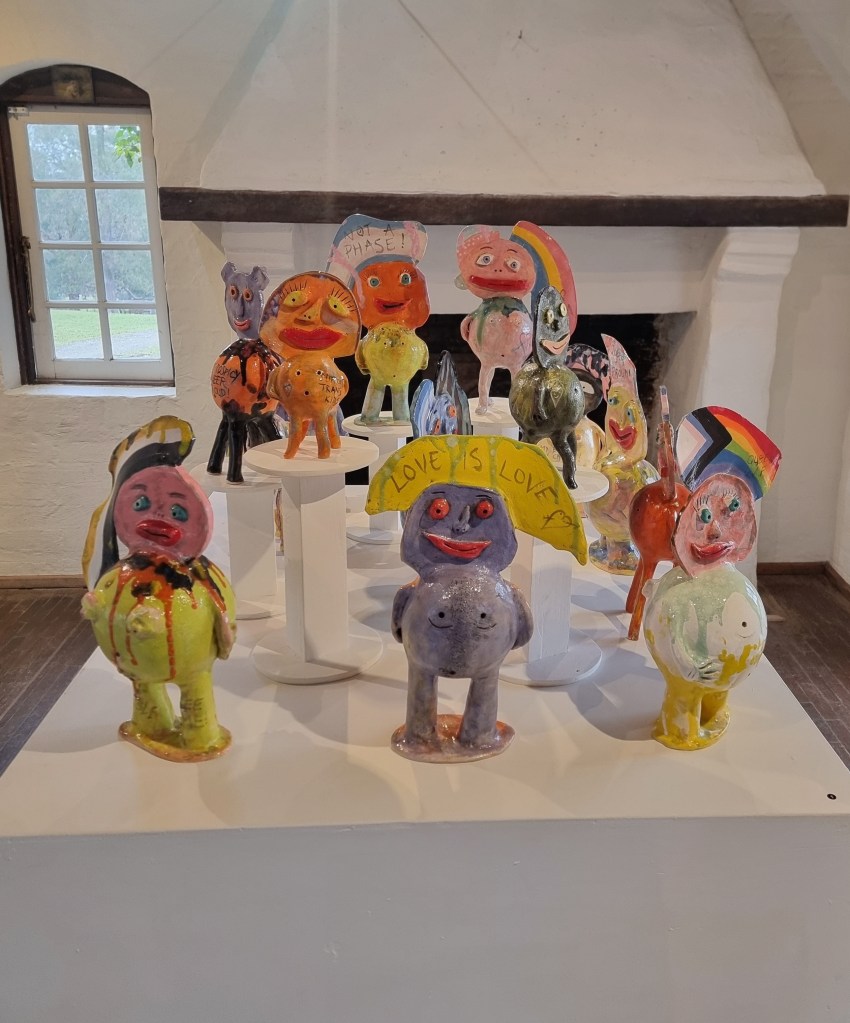
I came across this exhibition in the modestly-sized Residents Gallery at Montsalvat Artist Community. Historically, this space has been used for displaying small objects, such as jewellery or ceramics. Keeping to the tradition, Another Quiet Protest is composed of small to medium-scaled sculptures. Unlike these previous exhibits, however, these sculptures command the audience’s attention as soon as one steps into the room. Against the white walls of the space, the vibrant rainbow palette of these characters stand out, especially the crowd of figures on the central plinth facing the fireplace. With watchful, wide eyes and red smiles, the characters appear to have a life of their own. Looking closer, they carry individual messages, each representing a distinct identity from the LGBTIQ+ community. The seemingly simplistic appearance of these figures, from the flat faces to the circular bodies and short legs are reminiscent to cartoon characters from TV shows from the late 90s and early 2000s, but unlike these characters, these directly embody queer identities and messages. Like protesters holding signs, characters wear messages on their heads and bodies such as “Not a phase!” and “Love is love”, slogans that were reinforced during the Same Sex Marriage debate in 2017. Presented in such a nostalgic manner, these figures carry a poignant message to those who grew up watching such cartoons who had doubts about their identities within a heteronormative society: They reaffirm and validate doubts that could still be lurking within the inner child of a conflicted adult. The fact that these figures have all been handcrafted by the artist too, further demonstrates the deeply personal messages that the LGBTIQ+ community (particularly transpeople) have been putting forward but being continually misunderstood.
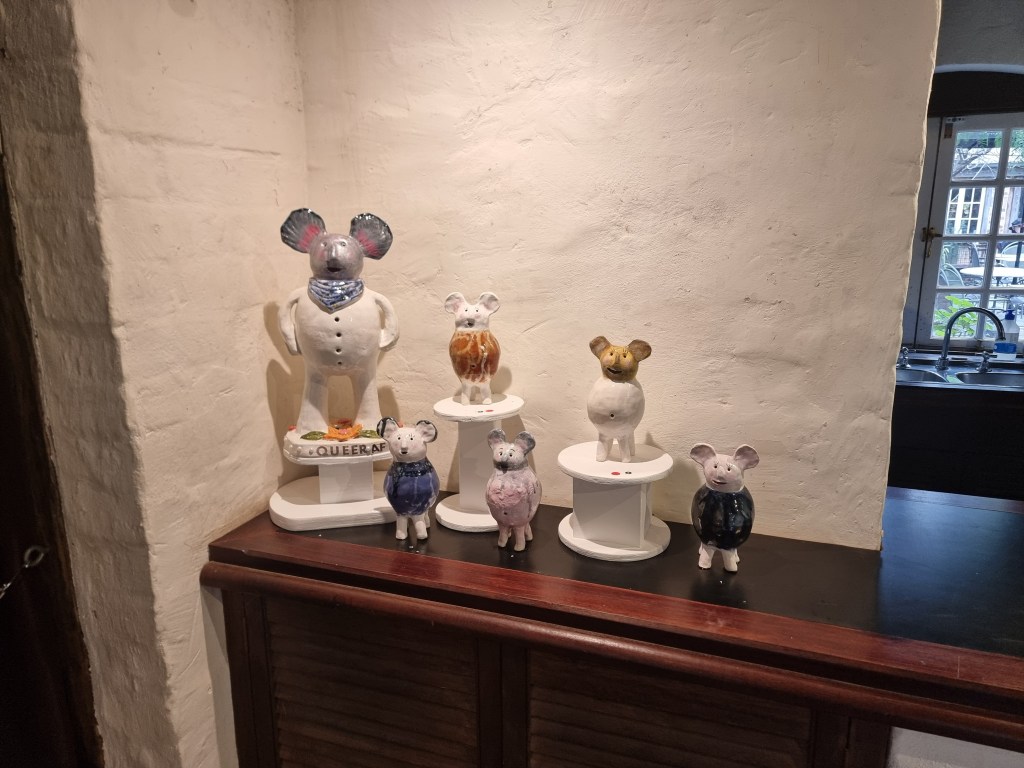
Walking around the space, there are many other characters within Alistair’s body of work. Charming animals such as cats and bears stand in small groups on plinths, round bodies coated in flags of both gay and transgender communities. Some of these also crowd on top of surfaces of furniture and architectural features, but I’ll get into that later. These sculptures are not ornate, yet they are far from being understated. While there are also some characters with animal features which wear no flag or message at all, they all fit in seamlessly with the rest of the exhibition. No two characters look the same, even though some may have similar features and clothing. Reading these works through a nostalgic lens once more, the dapper, mouse-like figures near the window in their suits appear as a jovial reference to The Wind In the Willows, a book that scholars and members of the LGBTIQ+ community have regarded as queer-coded. In presenting his characters with different clothing, heights and features, Alistair captures the diversity in human experience as well. Although we may belong to the same groups and communities, every human experience is unique. Thus, in this turbulent political time where “feminist” activists are trying to separate transwomen from femininity and pushing transmen into it, Alistair’s work causes us to pause and recognise that our differences should not be dictated by others, but recognised and gently supported.
The way these sculptures have been installed is also worth noting. Rather than being placed in a row or on individual plinths, the characters gather in small groups. If arranged as the former, this might invite comparison, which would place an unconscious bias towards certain figures, rather than seeing them all as parts of a unified whole. Conversely, on individual plinths, this could isolate the figures. That said, near the window, there are two figures that are on separate plinths. However, there is also a smaller figure between them on the window sill itself, which nicely challenges traditional curatorial techniques. In having the smaller figure between the two, this breaks up the individualistic, isolated layout that would otherwise be there, which brings the figures on an equal level. Additionally, figures gather together on on countertops as well as plinths, almost as if each one has their own signature way of wanting to make a statement. This provides variety for the viewer and prevents museum fatigue. No matter how different these figures may look or stand, not a single one is more important than the other. This curatorial layout alone thus, seems to reinforce the idea that throughout the LGBTIQ+ community, there are many individuals on different parts of their journey of self discovery and are equally valid. This takes a stand against gate-keeping by implementing curatorial techniques that show inclusiveness and hones in on the idea that every member in the community matters.
Furthermore, if we were to go back to the central plinth with the larger rainbow humanoid sculptures, the figures are standing together in a group as a silent, yet peaceful protest against the current division that has been permeating the LGBTIQ+ community, as well as society as a whole. Again, these figures are presented to be given equal attention, for the ones in the middle of the crowd are raised on plinths so that none will be obscured. The characters are watchful, but they are not aggressive. Rather, they appear almost curious, but gentle, loud in colour, yet quiet in sending messages. They make no apology for existing (nor should they), but are not abrasive in asserting their stance. This in turn takes a stand against stereotypes from alt-right and trans-exclusionary radical feminist forums of transpeople “shoving their views” down people’s throats. As Alistair states, these figures state quietly, yet firmly that transpeople “have always been here and we will not disappear.” They are not aggressive, but patiently waiting to be heard. And it is our job, as the audience, to listen.
Overall, Another Quiet Protest is an exhibition that is not only made from the artist’s own hands and individual experience, but one that responds to the aggression and vitriol that has been brewing and now engulfing the LGBTIQ+ community. It is a timely and vital exhibition that sculpts the unheard voices that are being drowned out by the tide of extremism. As I write this, it is hard to say what will happen in this age of Donald Trump’s second term as president, the rise of populism and trans-exclusionary radical feminism. Yet, seeing such a well curated and tenderly crafted body of work, it gives some hope. Alistair’s figures stand together in solidarity, holding messages for audiences that touch on nostalgia, identity and human experience. They make us stop and think more critically about what it is that we are directing our energy towards. Rather than argue over meaningless concepts such as binary gender, we need to instead accept and support one another’s differences, stand together and try and get through the conflict that is threatening to tear our world apart. Because in the end, even though we are all different, we each have our own struggles, so isn’t it better to support one another, rather than to get through them alone?
Another Quiet Protest has now concluded at Montsalvat. If you’ve missed out, it will be displayed at the Pride Gallery from 12 November 2025 – 8th January 2026.
 Critical Art Writings
Leave a comment