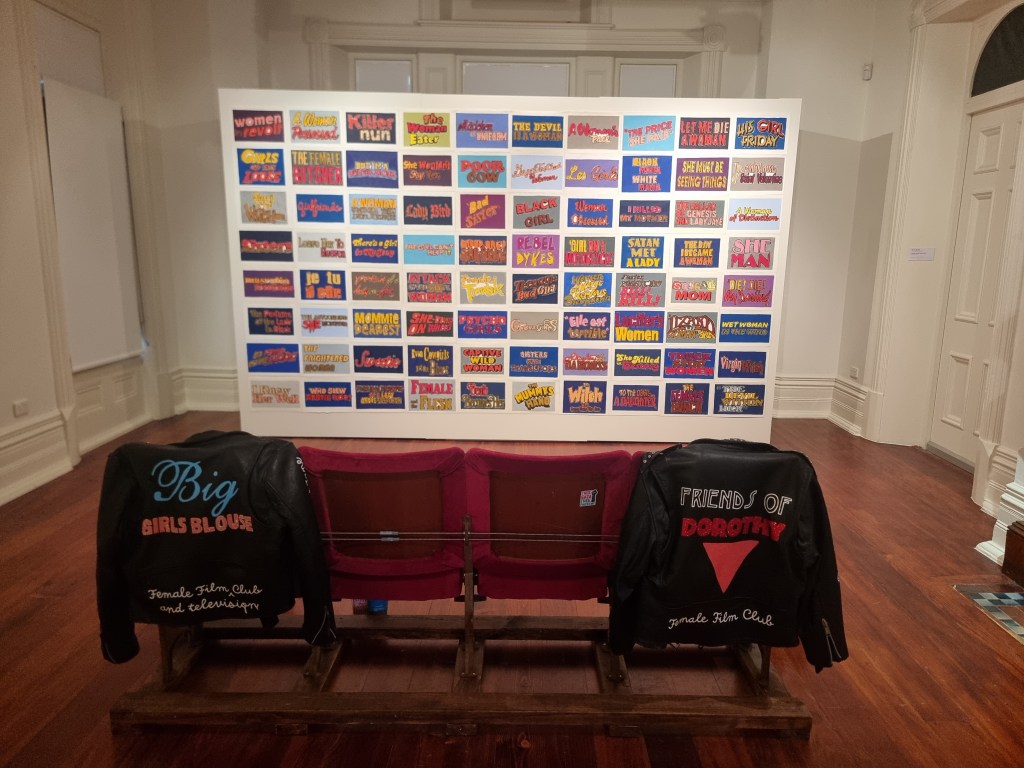
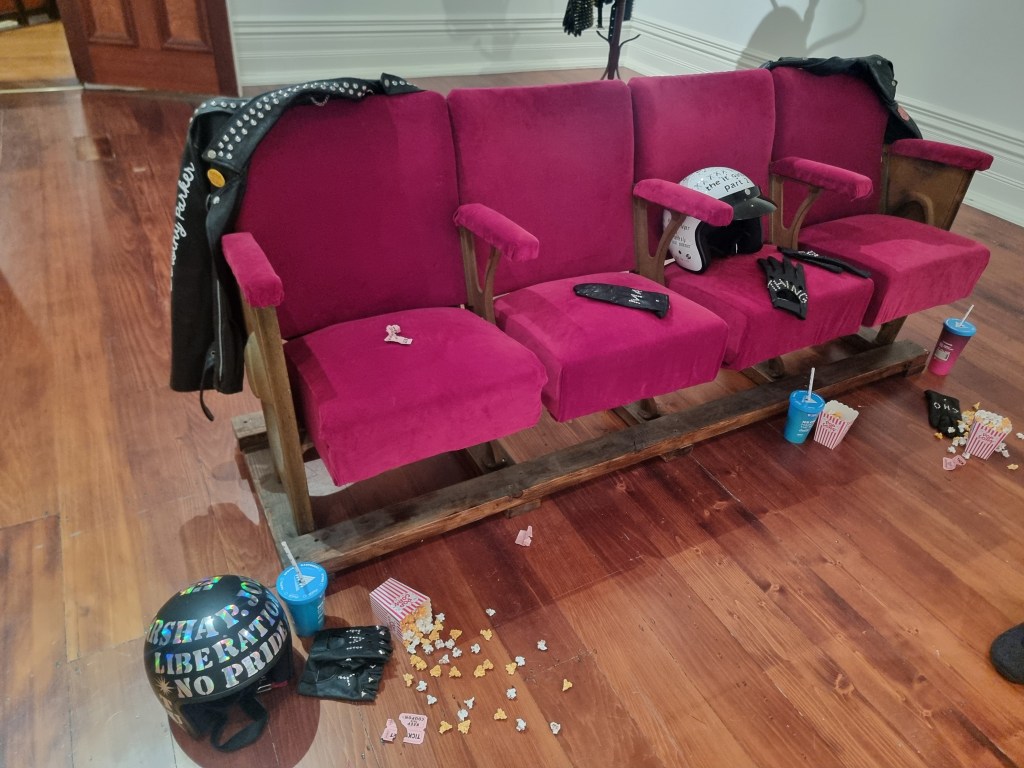
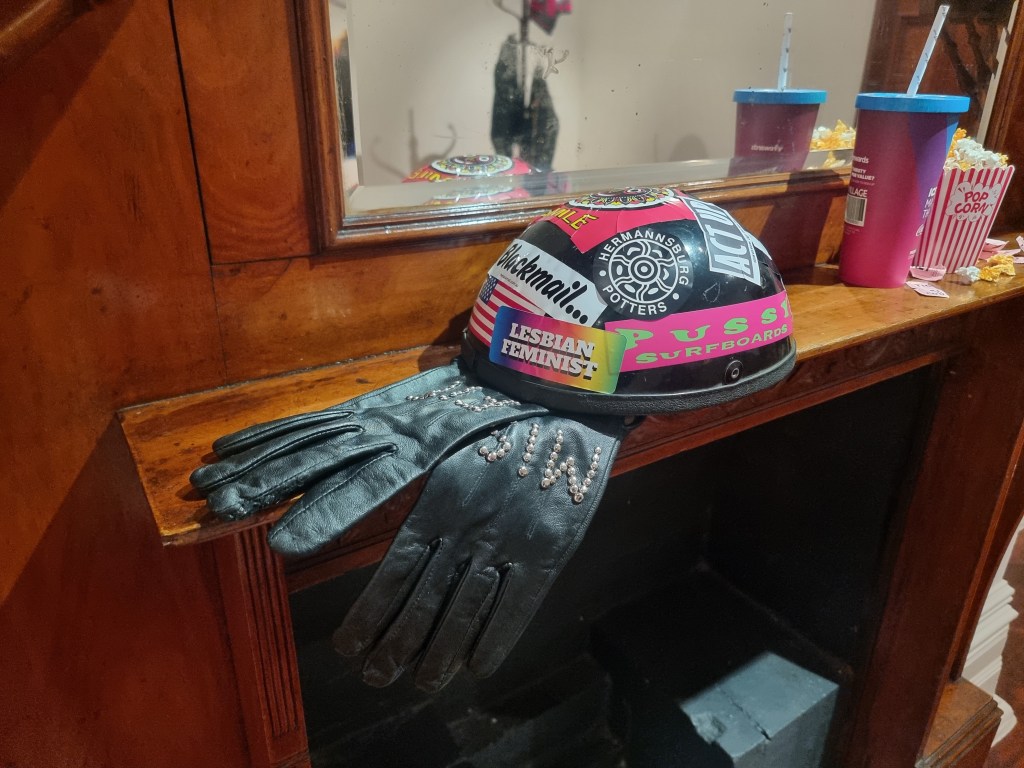
Pia de Bruyn’s Female Trouble, much like the other exhibitions at Bundoora Homestead, takes on a conceptual form. A group of plush, red seats (reminiscent to that from a cinema) sit at the centre of the room, facing a white wall. A montage of various movie titles are stuck on the wall, the text with bold colours such as reds and yellows, while the backgrounds are mostly of cooler tones. Upon closer glance, these titles have all been hand drawn and coloured in pastels, giving the titles more of a gritty appearance. Draped over the backs of the cinema seats are two leather jackets, some of which are emblazoned with queer slogans such as “Friends of Dorothy”. Leather jackets are also hung on the hatstand further back, and motorcycle helmets sit on the seats, floor and balance precariously on the hatstand. Studded leather gloves too, are scattered throughout this scene, and also appear on the ornate wooden fireplace to the right behind the chairs. To further enhance the cinematic atmosphere, ripped movie tickets and (artificial) popcorn scatter over the floor, with empty paper cups sitting on the dressing table and floor. The props are striking, with the studs and brightly coloured slogans on the helmets and jackets overwhelming the titles that are on the wall: It is clear that these props take centre stage, rather than the films that are being “shown.”
For someone who has not watched most of the films that are depicted in this installation, the message is not overt. Yet, according to the wall text, this elaborate set up is meant to provide a cinematic setting: The movie titles drawn on the wall are all fairly old movies which in one way or another depict (negative) stereotypes of women, especially queer women. On first glance, the spilled popcorn, torn tickets and neglected drinks seems to reveal the aftermath of a film that caused movie goers to leave in disgust. The way in which various garments and props have been littered throughout the space, and especially left on the ornate fireplace almost signals a disapproval for the way in which the media has portrayed outdated stereotypes of women. At the same time however, this “trashing” of the cinematic space seems to also suggest a reclaiming of the space: Queer bikie paraphernalia dominate the space, threatening to take it over. Rather than simply accepting these films for what they are, these bikies take over the space, creating some kind of disorder in the hopes that this will spark much-needed change in the way that women are portrayed.
While there are elements of this installation that create a scene that is more effective than some other conceptual works, the message is still largely dependent on the wall label. The layout does portray a cinema-like setting, but perhaps this would have been even clearer if a slideshow was projected on the wall, as opposed to the montage of hand drawn film titles. By having a moving image, this would better enhance the idea of this installation being a cinema, with the titles being products of films. Female Trouble commands the audience’s attention and challenges the way this space would normally be used. Yet, for those who do not have an understanding about film history, or have never seen the films that have been mentioned in this installation, the message is lost. A way to remedy this would be to perhaps reference films that are more well-known to a wider audience that showcase a similar problematic stereotyping (there is a wealth of material for this, even from the 2000s!). But by having films that seem more like cult-classics, this installation becomes restricted to only dedicated cinephiles, or those with extensive knowledge in film history. Even to this day, women (and those who identify as women within the LGBT+ community) are still subjected to negative stereotypes. The continuation of populism throughout the world and an uprising of conservative views makes this message all the more crucial. Wouldn’t it then be more conducive if Female Trouble was presented in a way that is more accessible to a wider audience so that we as a society are more conscious of our treatment of women?
Although the use of the Bundoora Homestead provides a jarring background to a very contemporary installation, it might not be the best location for portraying such an important message. The ornate furnishings give this room more of a domestic background, which can be alienating for audiences who see the staging of a cinema. Given its cinematic focus, Female Trouble would be better suited to a heritage cinema space, perhaps the 1812 Theatre in Upper Ferntree Gully (although far), or the nearby Northcote Theatre. This is because audiences who are more likely to have seen these films, or at least be familiar with them, would be better positioned to see this installation, and thus, be moved by it. While I understand that Pia is trying to challenge heteronormative, patriarchal spaces, the installation might have more of an impact in a similar context to the one she is trying to emulate, rather than in a heritage homestead. Still, it is a work that has a lot of promise, and makes us aware of an ongoing issue that will only get worse without a critical viewing of media that is being consumed (and still being made). It is a timely work, yet just a few adjustments could be made to either make the message clearer, or bringing it into a context that is similar.
If you’ve seen this exhibition and have a different take, or are familiar with the films Pia is referencing, we’d love to hear from you. Otherwise, keep an eye out for Part 5, for an analysis on Arranging by Chance.
 Critical Art Writings
Leave a comment