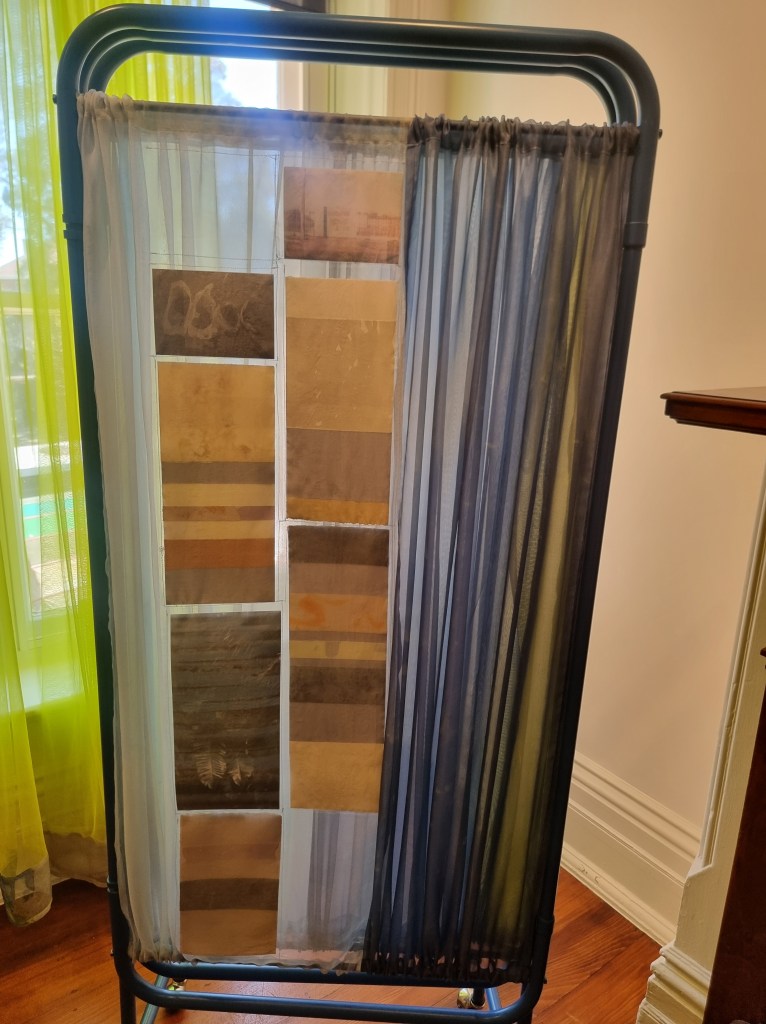
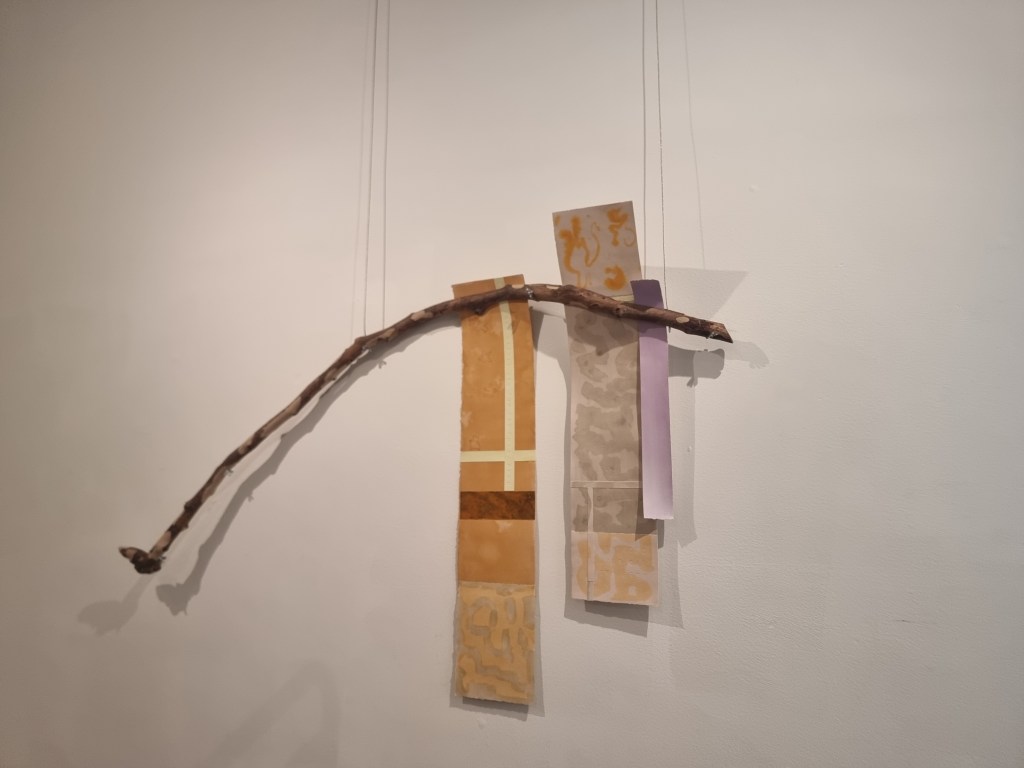
The next, and last exhibition to see in the homestead is a collaborative exhibition, Arranging by Chance by Abbra Kotlarczyk and Briony Galligan. Works are primarily a mix of photography, drawing and found objects (though there are some written and verbal texts). However, none of these works are presented conventionally. Rather, they are all arranged in combinations and scattered around the space in a way that appears to be haphazard, but is meticulously planned. Looking around, there are works that are attached to hospital curtain dividers, which could perhaps be a reference to the homestead’s history as a repatriation centre and hospital. The drawings appear to be abstract in nature, while the photographs are mostly (presumably) under and overexposed landscapes or closeups of objects, the subjects not easily discerned. Although there was a reason for putting these works together on the curtain dividers as a collection, these works appear all the more obscure and overwhelming to look at as opposed to being displayed individually. On the walls, there are a couple of wall arrangements, the likes of which are reminiscent to constructivist Vladimir Tatlin’s The Corner Counter Relief (1914-1915), though instead of using already treated materials, a branch is combined with the hanging paper works. It is an unusual mix of two dimensional and found objects that awkwardly tethers on the boundary between sculpture and painting. There is also what appears to be a branch or snake-like object, that sits partially in the fireplace.
So what does it all mean? This exhibition, unlike the other conceptual ones, is relevant to the heritage space, yet without reading the contextual labels, the meaning is still difficult to perceive. According to the contextual label, the theme focusses on family trees, queerness, as well as the traumatic elements of family such as toxicity. Abbra Kotlarczyk and Briony Galligan explore the latter both figuratively and literally by looking at various sites of toxicity, contamination and death. These sites, though not of Bundoora Homestead, seem to have some similarities to it: Decommissioned NuFarm Factory, Fawkner, a childhood property and ex-banana plantation in Northern NSW, and the AIDS Memorial Garden outside the old Infectious Diseases Hospital in Fairfield. These are all sites with very loaded histories, and although these are nowhere near the homestead, they connect at least in terms of having connections to hospitals and trauma. The works on paper, which hang on the curtain dividers give a nod to the curatorial theory of site-specificity, as the artists want to emphasise that the space is not simply a place to display works, but one that is integral (and inseparable) to the subject of the work. In having these works on the curtain dividers, the artists want us to be aware of this connection. Making these connections to these sites within a heritage space like Bundoora Homestead is clever, yet presentation-wise, these ideas are lost on the audience, unless they already have an understanding on site-specificity. As mentioned earlier, the photographs and drawings are created in a way that still invites ambiguity, rather than explicitly conveying the ideas of toxicity, family trees, queerness or trauma. One could argue that the use of branches on the wall and in the fireplace give some kind of reference to a family tree. But these are all placed in different points of the room, rather than connecting with one another the way a tree would. Perhaps, the only reason as to why these branches of the family tree are presented so far apart from one another is due to the traumatic experiences of family rejection, and having to make one’s own family (which is a plausible theory, given the reference to queerness). Unfortunately though, none of these meanings are really clear, and I do not even know if I’m simply drawing a long bow here with my own interpretations.
I will say that the exhibition does at least uphold conservation standards, which can be noted by the filtered curtains and the security lights, which only switch on in the room when someone walks in. Having seen many other exhibitions, this is about the only space in which the comfort of the viewer and the preservation of the work is equally balanced: Too many of the bigger exhibitions tend to turn the lights very low so to better preserve the works, yet compromise the viewer’s own comfort and experience. As the lights switch off after audiences have left, this helps to preserve these works on paper, which are fragile against light (and oddly enough entirely contradicts the message of the first exhibition we saw). The clean white walls and professional hanging systems too, make this space optimal for many different types of exhibitions. All these elements begs the question as to whether this space is restricted and underutilised for what it is. But I will get to that later.
While Arranging by Chance is an exhibition with interesting topics worth exploring, while also connecting well with the heritage of the space, the highly conceptual use of found objects and unconventional display of works on paper can throw off and confuse the general public. Although the wall labels provide everything audiences need to know about the work, these should not be sorely used to understand the work: the works themselves should be able to speak for themselves, while the text merely clarifies what is being presented. Yet, when viewing this exhibition, it was pretty difficult to know why these objects or works were presented the way they were without context or some understanding in curatorial theory. These are all deeply personal topics, and in having to impose my own interpretation to the works from the scant information in the contextual label, it feels like I might be completely off the mark in understanding what these artists are saying. The label seems to tell us about the works thematically, yet like the works on paper, it does not give away much. It seems to be more of a case of telling, rather than showing, which sadly defeats the purpose of having all the works there. Should we really be relying on labels to tell us what we are looking at, or can works be made in a more accessible way for wider audiences?
I will leave you to ponder that question. Feel free to express what you think in the comments below. Otherwise, stay tuned for my final thoughts in the next blog post.

 Critical Art Writings
Leave a comment